
How to Read Sealant Technical Data Sheets: A Professional Buyer’s Guide
A Technical Data Sheet (TDS) is often the first — and sometimes the only — document professionals review before deciding on a sealant for their project. But does it tell the whole story? Not entirely. While it provides essential product specs, understanding what’s missing and how to interpret what’s provided is key to making informed decisions.
What a Technical Data Sheet Reveals About a Sealant
Purpose and Role in Professional Purchasing
A TDS functions as a product’s technical passport. It outlines physical and chemical properties, application instructions, and performance benchmarks. For buyers, it’s crucial in verifying whether a sealant meets the project’s technical demands.
A TDS supports selection by ensuring the product’s characteristics — like movement capability or adhesion — match the joint dynamics and environmental conditions. But numbers on paper must align with field results.
Limitations of Technical Data Sheets
TDSs rarely mention long term durability under site specific conditions or compatibility with unusual substrates. They also don’t describe failure cases, degradation patterns, or rework implications.
To cover these gaps:
- Look for additional documents like Safety Data Sheets (SDS)
- Ask for test reports (ASTM, ISO certifications)
- Validate claims via sample testing or direct consultation with the manufacturer
Key Product Information to Examine First
Product Identification and Description
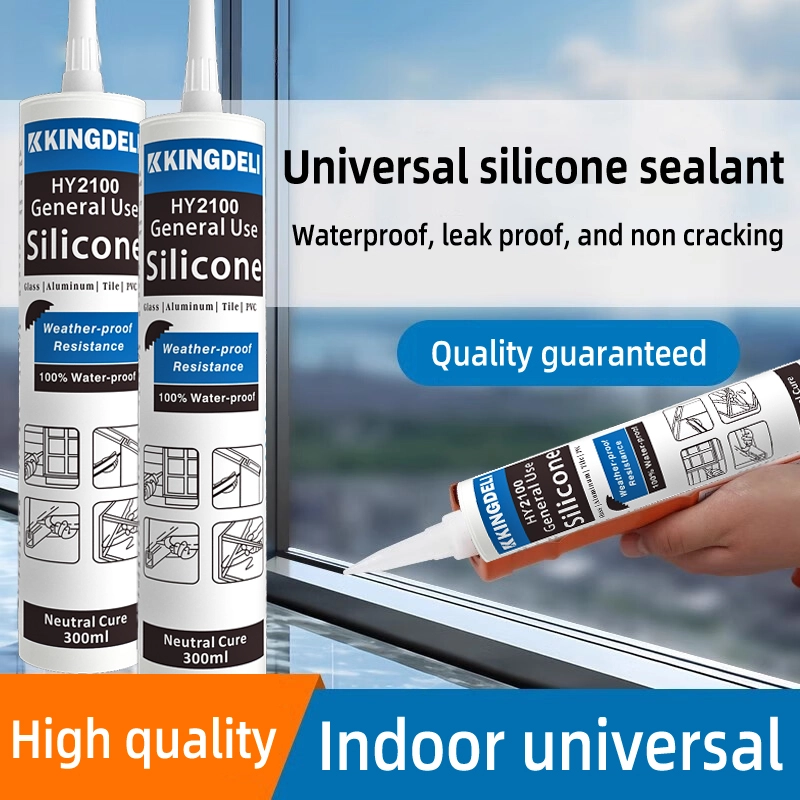
Check the naming conventions — codes like HY-3300 or HY-2100 indicate product families at Kingdeli.
Descriptions help match product to project. For example, HY-2300 Outdoor Neutral Silicone Sealant suitable for a wide range of glazing and weatherproofing tells you it’s built for curtain walls and outdoor joints.
Base Material and Chemical Composition
Know your base:
- Acrylic acid: Cures by losing water, resulting in a relatively hard material after curing; mainly used for sealing doors and windows;
- Silicone: Possesses good weather resistance, durability, and flexibility, but has poor aesthetic properties.
- Polyurethane: It has good cold resistance and wear resistance, but its heat resistance is inferior to that of silicone.
Each type behaves differently in terms of flexibility, adhesion, resistance to temperature, and UV exposure.
Curing Mechanism and System Type
The curing mechanism of single component products is related to environmental climate; This means curing rate depends heavily on ambient moisture and temperature — critical for scheduling installation.
Two part systems (e.g., structural silicone) offer faster and more predictable curing but require precise mixing.
Technical Properties That Influence Selection
Density Measurements and Their Implications
Acrylic sealants with lower density yield more volume per cartridge, affecting coverage rate. High density polyurethane sealants may provide better mechanical properties but at higher material usage per meter.
Shore A Hardness Ratings
Hardness affects both toolability and movement absorption. Typically 10 is the softest and 60 is the hardest. Softer sealants (20–30 Shore A) are preferred for dynamic joints, while harder ones (>50) are better for rigid installations.
Elongation at Break Values (%)
Elongation at maximum tensile strength (%): The extent to which the test specimen stretches before breaking; Elongation shows how much a cured sealant can stretch before breaking — important for areas with vibration or thermal cycling.
Movement Capability (±%) in Joint Applications
Different from elongation, this metric refers to the percentage of expansion/contraction the sealant can handle while still performing effectively. A ±25% rating is considered good for most architectural joints.
Temperature Resistance Range
Silicone sealants from Kingdeli like HY-3300 perform between the temperature of -50℃ ~+200℃ after curing. This range ensures stability in both freezing winters and scorching summers.
Tensile Strength Metrics (MPa or N/mm²)
For structural use — like glass curtain walls — tensile strength needs to meet thresholds such as 0.4 MPa or higher under GB/16776-05 standards.
Evaluating Performance Characteristics for Real Applications
Skin Formation Time and Full Cure Duration
Silicone sealants may form skin within 20–30 minutes, but full curing can take 24 hours or more depending on humidity. Timing matters when sealing must be painted over or exposed to water shortly after application.
Adhesion to Common Substrates
Good adhesion to various substrates is common for polyurethane, while silicone bonds well with glass, metal, and ceramic. Test reports should specify performance across materials like PVC, aluminum, and stone.
Resistance to UV Exposure and Weathering Cycles
Exterior grade silicones such as Kingdeli HY-3300 emphasize Excellent water resistant, UV resistance and weather resistant. Always verify if the TDS mentions artificial aging tests like ASTM G154.
Application Parameters That Affect Field Performance
Surface Preparation Guidelines
Most TDSs suggest cleaning with solvents or primers. Applying on damp surfaces may cause bubbling — especially for polyurethane (It should not be applied to damp or wet surfaces).
Joint Design Recommendations from TDS Data
Ideal width to depth ratios are often 2:1. Overfilling narrow joints with high modulus products can lead to premature failure due to stress concentration.
Application Techniques Specified by Manufacturer
Use pneumatic guns for consistent extrusion; manual guns may struggle with higher viscosity formulations like construction grade PU sealants.
Coverage Rates Based on Joint Dimensions
A standard 300ml cartridge covers ~3 meters of a 10mm x 10mm joint. Use:
Coverage = Cartridge Volume / (Joint Width × Joint Depth)
Storage Instructions and Shelf Life Considerations
Recommended Storage Conditions from Manufacturer Guidelines
Sealants must be stored below 25°C in dry conditions. Heat or moisture exposure shortens shelf life.
Shelf Life Indicators on TDS Documents
For Kingdeli products, cartridge 9 months/12months, aluminum foil 12 months. Check batch codes regularly for inventory management.
Certifications That Indicate Quality Compliance
International Standard References (ISO, ASTM)
Products tested under ASTM C920 or GB/T14683-2017 ensure standardized performance levels in terms of modulus, adhesion, elongation, etc.
Regional Approvals (CE Marking, UL Listings)
If your project is in Europe or North America, check for CE marking or UL listings indicating regulatory conformity.
Environmental Declarations (VOC Content, LEED Credits)
Low VOC sealants like Kingdeli HY-2300 help meet indoor air quality targets and earn LEED credits.
Methods for Comparing Multiple Sealant Options Efficiently
Building a Technical Comparison Matrix
Create a spreadsheet comparing parameters like:
- Shore A hardness
- Movement capability
- UV resistance
- Cure time
This helps filter out products that don’t meet key specs quickly.
Evaluating Trade offs Between Performance Metrics
High hardness often means lower flexibility. Faster curing may reduce working time. Balance these based on your application priorities.
Common Issues to Watch Out For When Reading TDSs
Missing or Incomplete Technical Information
Be wary of vague language like “excellent performance” without test references. Absence of ASTM/ISO benchmarks is a red flag.
Overly Optimistic Claims Without Test Basis
Claims like “cures in 5 minutes” or “works on all substrates” should be challenged unless backed by data.
Poor Manufacturer Transparency or Contact Access
Ensure technical support is accessible — brands like Kingdeli back their products with clear documentation and export service experience spanning over 10 years.
FAQs
Q1: Can I rely solely on the TDS to choose a sealant?
No. Use it as a starting point but confirm with test reports or field trials when needed.
Q2: How do I estimate how much sealant I need?
Use the formula: Volume = Width × Depth × Length. Divide by cartridge size for quantity.
Q3: What’s the difference between shelf life and service life?
Shelf life refers to storage duration; service life is how long the product performs after application.
Q4: Why do two sealants with similar specs behave differently?
Formulation differences impact real world behavior — always test on your actual substrate.
Q5: What if my substrate isn’t listed in the TDS?
Contact the supplier’s technical team to check compatibility or get testing recommendations.