
The Pros and Cons of Using MS Polymer Adhesives in Industrial Settings
Overview of MS Polymer Adhesives in Industrial Applications
Key Characteristics of MS Polymer Adhesives
MS polymer adhesives, usually seen as hybrid sealants, mix the top qualities of silicones and polyurethanes. Their makeup lacks solvents and isocyanates. This setup aids safe use. It also helps meet tough environmental rules. So, they serve as a better choice in jobs where harmful stuff matters.
These adhesives offer great bendiness and solid strength. They stick well to different materials like metals, plastics, and composites. A main feature that makes MS polymer adhesives special is their strong UV resistance and no-stain quality. That suits them for jobs where joints show or stay open to view.
MS adhesives come from end-functionalized siloxane polyethers as the base polymer. The polymer’s main chain has soft polyether parts with fairly low heat breakdown energy. Meanwhile, the side chains hold terminal silane groups as end-capping parts. This leads to a somewhat weak crosslinking density. And this base setup gives MS adhesives their bendiness. Yet it also sets their limits in tough settings.
Common Industrial Uses of MS Polymer Adhesives
MS polymer adhesives get used a lot for joining unlike materials. This makes them useful in setups with aluminum to PVC, or ABS to stainless steel. Their all-around nature reaches sealing tasks in the automotive, marine, and construction fields. They manage joint shifts without breaking. That’s key in busy spots like vehicle insides or outside walls.
People also pick them for work that follows green building rules. Why? Because of their low VOC emissions and no bad solvents.
Performance Advantages in Industrial Settings
Flexibility and Movement Accommodation
A big plus for MS polymer sealant is how they handle shifts. It could be shakes from engines or heat growth in composite panels. These adhesives keep their stick strong. Take vehicle setups where metal bonder work counts under moving loads. Here, MS adhesives give steady stretch.
Weathering and Environmental Resistance
MS polymers show good defense against weather effects. Think UV rays, water, and changing temps. So, they fit well for outside setups or sea areas. In those spots, old adhesives might wear out. MS adhesives have poor temperature resistance. They start to break down at about 150℃. And the first breakdown stage of the base polymer ends at around 430℃. All the same, this points out that while everyday weather defense holds up, super high heat has bounds.
Paintability and Aesthetic Integration
One clear gain is how they take paint. After they set, MS polymer sealants let you paint over them. This won’t hurt the stick or look. It’s better than silicone-based sealants, which often push back paint. This side shines in building design and inside finishes. There, matching looks really counts.
Health, Safety, and Environmental Considerations
MS polymer adhesives skip isocyanates and risky solvents entirely. That boosts air quality while working. It cuts health dangers for workers too. Their low smell mix also ups comfort for users on the job. It’s a minor point, but nice during long work times.
Limitations to Consider When Selecting MS Polymer Adhesives
Curing Time Variability
How long curing takes can change with room humidity and temp. In dry spots, the process might drag on. The curing way for one-part items ties to surroundings. Higher temp and wetness speed it up. So, this matters for planning work or site jobs.
Plus, full strength might build slower. That means parts could need holding or propping longer than quick-set types.
Structural Bonding Strength Constraints
MS polymers do fine as bendy adhesives and sealants. But they don’t fit as main structural ones where big pull or slide strength is key. For jobs needing strong load hold, folks still use epoxy or polyurethane systems. Those give better carry power.
Surface Finish Challenges During Application
With their thicker flow, MS adhesives call for careful shaping to get even joints. Prep of surfaces is vital. Not just for stick, but for a smooth look too.
Cost Factors and Economic Considerations
Price Range Compared to Other Adhesive Types
MS polymer adhesives usually cost between silicones and polyurethanes per unit. They might not seem cheap at first. But their lasting work can balance that by cutting fixes or fails over time.
| Adhesive Type | Typical Unit Cost | VOC Level | UV Resistance | Paintability |
| Silicone Sealant | Low | Low | High | Poor |
| Polyurethane | High | Medium | Moderate | Moderate |
| MS Polymer | Medium | Low | High | Excellent |
Efficiency Gains Through Simplified Application Processes
As one-part setups, MS polymer adhesives skip mixing needs. This cuts mistakes and work costs. They work with auto dispensing gear too. That boosts output in big production runs.
Material Compatibility Across Industrial Substrates
Performance on Metals, Plastics, and Composites
MS adhesives stick solidly to many bases. That includes aluminum, stainless steel, PVC, ABS, GRP, and even painted or powder-coated spots. Often, no primers are needed if prep is right.
Suitability for Hybrid Assemblies in Manufacturing Lines
In today’s assembly lines, like those making appliances or car insides, joining soft fabrics to hard plastics happens often. MS polymer adhesives do great here. They balance stretch and stick power well.
Comparative Evaluation with Other Adhesive Technologies
| Feature | MS Polymer Adhesive | Polyurethane Based Adhesive | Silicone Sealant |
| UV Resistance | High | Moderate | Excellent |
| Structural Strength | Moderate | High | Low |
| VOC Emissions | Very Low | Medium | Low |
| Paintability | Excellent | Moderate | Poor |
| Surface Dirt Pickup | Minimal | Moderate | High |
Differences from Polyurethane-Based Adhesives
Polyurethane adhesives bring stronger structural stick. But they need trickier handling from isocyanate parts and two-part mixes. On the flip side, MS polymers give safer work spots and better UV hold.
Advantages Over Silicone Sealants in Industrial Use
Silicone sealants stand out for solid weather defense. Yet they push back paint and pull in dust as time goes. Silicone sealants possess characteristics such as weather resistance, seismic resistance, moisture resistance, odor resistance, and the ability to withstand large temperature fluctuations. Still, MS polymers boost mechanical stick on non-glass spots. They also give top paint-ready surfaces after setting.
Practical Considerations for Implementation in Production Environments
Factors Influencing Adhesive Selection Decisions
When picking an adhesive setup, engineers ought to check:
- Substrate type (metal bonder compatibility)
- Environmental exposure (UV, humidity)
- Load-bearing needs (structural vs flexible)
- Assembly processes (manual vs automated)
- Total lifecycle cost (not just price per kg)
A full look makes sure of not just work, but also smooth production.
Insights from Manufacturers Specializing in Sealant Solutions
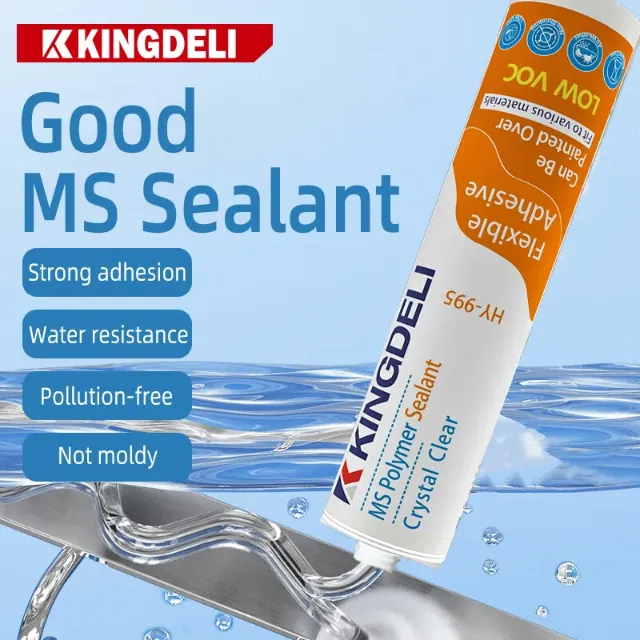
Firms like Kingdeli have made field-specific MS polymer mixes. For instance, types tuned for waterproofing or shake control. Such custom fixes help makers tackle special issues. They do so without losing speed or rule-following.
Working with adhesive makers can lead to made-to-order options too. That’s when ready-made ones don’t quite fit.
FAQ
Q1: Is MS polymer adhesive suitable for bonding metals?
Yes, it performs well on metals like aluminum and stainless steel even without primers if surfaces are prepared properly.
Q2: Can MS polymer adhesives be used outdoors?
Absolutely. They offer strong UV and weather resistance for exterior applications.
Q3: Are MS polymers safe to use indoors?
Yes, they are solvent-free with low odor and no isocyanates—ideal for enclosed spaces.
Q4: How fast do MS adhesives cure?
Cure time depends on humidity and temperature; typically 2–7 days for full strength in standard conditions.
Q5: Can MS adhesives replace structural adhesives?
Not entirely. While strong and flexible, they aren’t ideal where high tensile strength is critical.