
How to Bond Skirting Boards with Construction Adhesive: A Guide to Surface Preparation and Support
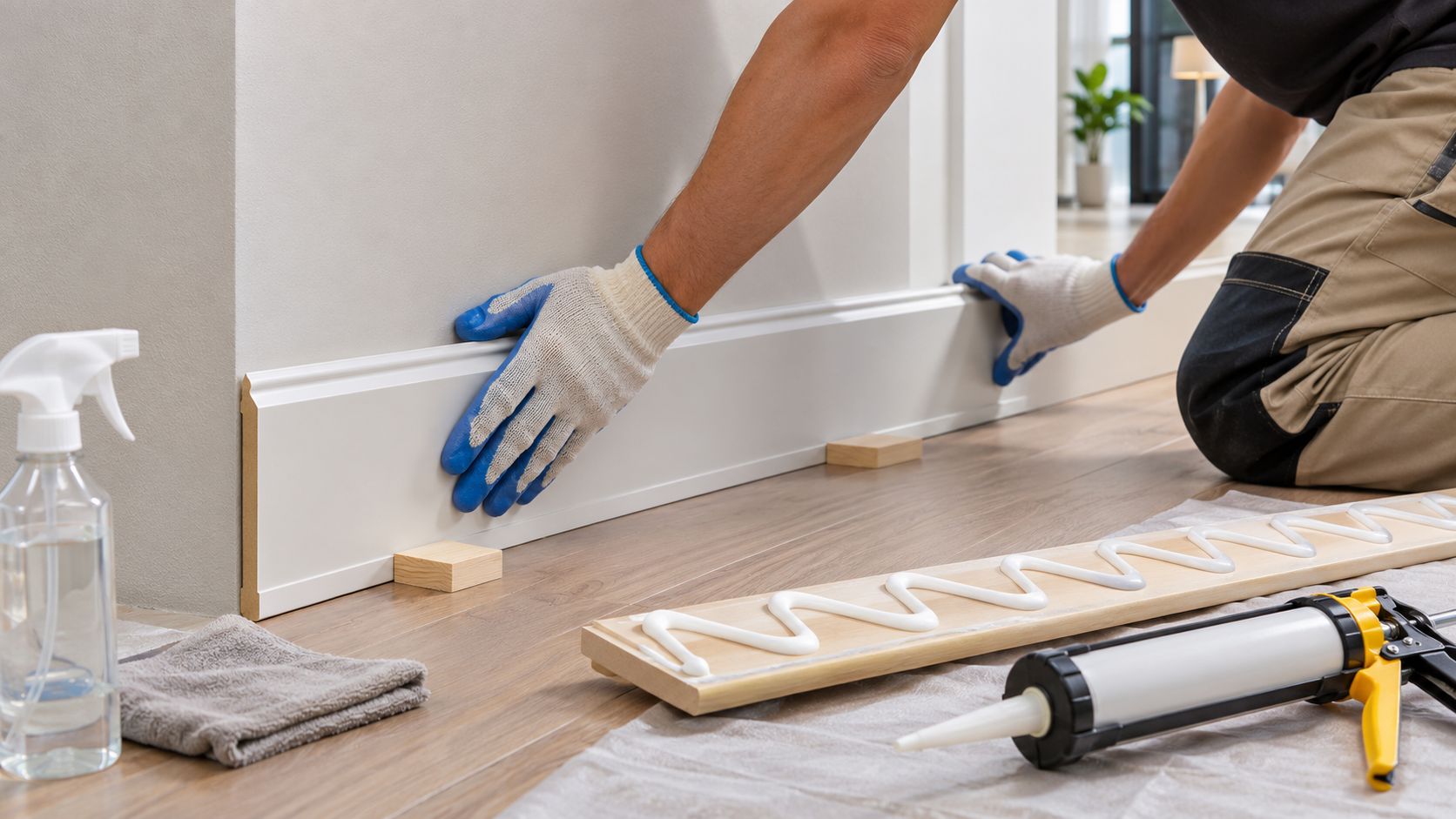
“Which glue should I buy?” is a fair question for a skirting job, but an offcut and a look at the wall are useful parts of the answer. When I compare construction adhesive for skirting boards, I’d want to know what’s on the board’s back and what’s covering the wall. I’d also want to know how the installer will hold the pieces together during cure. If the cuts won’t meet or the paint is coming off, I’d address that before comparing cartridges.
Checking How the Skirting Fits
Trying the cut pieces without glue is the dry fit. Include the short returns, which can be easy to overlook when attention is on a long wall. The whole run is worth trying; the middle of one board doesn’t tell you how its ends will meet the next pieces.
Material choice enters the job here too. The No More Nails range includes products with different application descriptions, so the board’s backing is worth noting before making a shortlist. A finished front tells you little about that face. A coated backing needs identifying as such, rather than describing it only by the board’s core material.
Contact along a Straight Length
The useful observations are where a length touches and where it won’t stay put. These become your notes for correcting the fit or arranging support. A large gap raises another question. More glue is a poor guess when you haven’t established whether the product permits that joint arrangement.
Fit at Corners and Returns
I’d try adjoining corner pieces as a pair. There’s little value in a joint that closes only by pulling one board off its wall. With the pieces still clean, you can take them back for adjustment. Numbering the backs avoids mixing up the fitted sequence. At a doorway, it’s also worth working out how you’ll manoeuvre the longer pieces into position.
What the Glue Will Touch
With the fit sorted, consider the wall face. A coated board against old paint presents two finished surfaces. Bare board against sound plaster presents a different joint. Neither can be approved merely by seeing “no more nails” on a cartridge.
There’s no advantage to bonding a board to a layer of dust, and loose filler is no better. With peeling paint, you could end up with a board, glue and paint film all firmly stuck together, but no attachment to the wall. Loose material has to come away during preparation. Where repairs or repainting are recent, I’d check the required drying condition with the filler or paint instructions instead of going by how the surface looks.
An offcut bonded to a representative wall finish is one way of trying an unfamiliar combination. Use the planned preparation and give it the specified cure. If it fails, the two halves are worth keeping. Paint transferred onto the adhesive, with plaster now showing on the wall, is a reason to look at the coating. Adhesive that lets go of an intact surface leaves a different set of questions about contact, compatibility and preparation.
What HY-963’s Initial Grab Means for Skirting
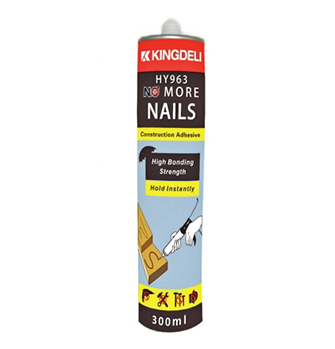
HY-963 No More Nails Construction Adhesive belongs to KINGDELI’s interior-grade products and is described as one-component and solvent-based. KINGDELI lists strong initial grab and no slump on vertical surfaces, and names rubber and glass skirting among its applications. For other backings, the page also names timber and MDF board; gypsum plasterboard and concrete are listed too.
The appeal of initial grab is easy to see when you’re positioning a long piece. But placing a board and leaving it to cure are separate operations. The real installation still needs to match the material and application guidance. A term describing early handling shouldn’t become a promise that support is never needed.
HY-963’s interior grade sets a boundary too. For outside work, the question has to be reopened rather than answered by pointing to waterproofing elsewhere in a property list. The supplier needs to know the proposed exposure.
Holding the Boards through the Cure
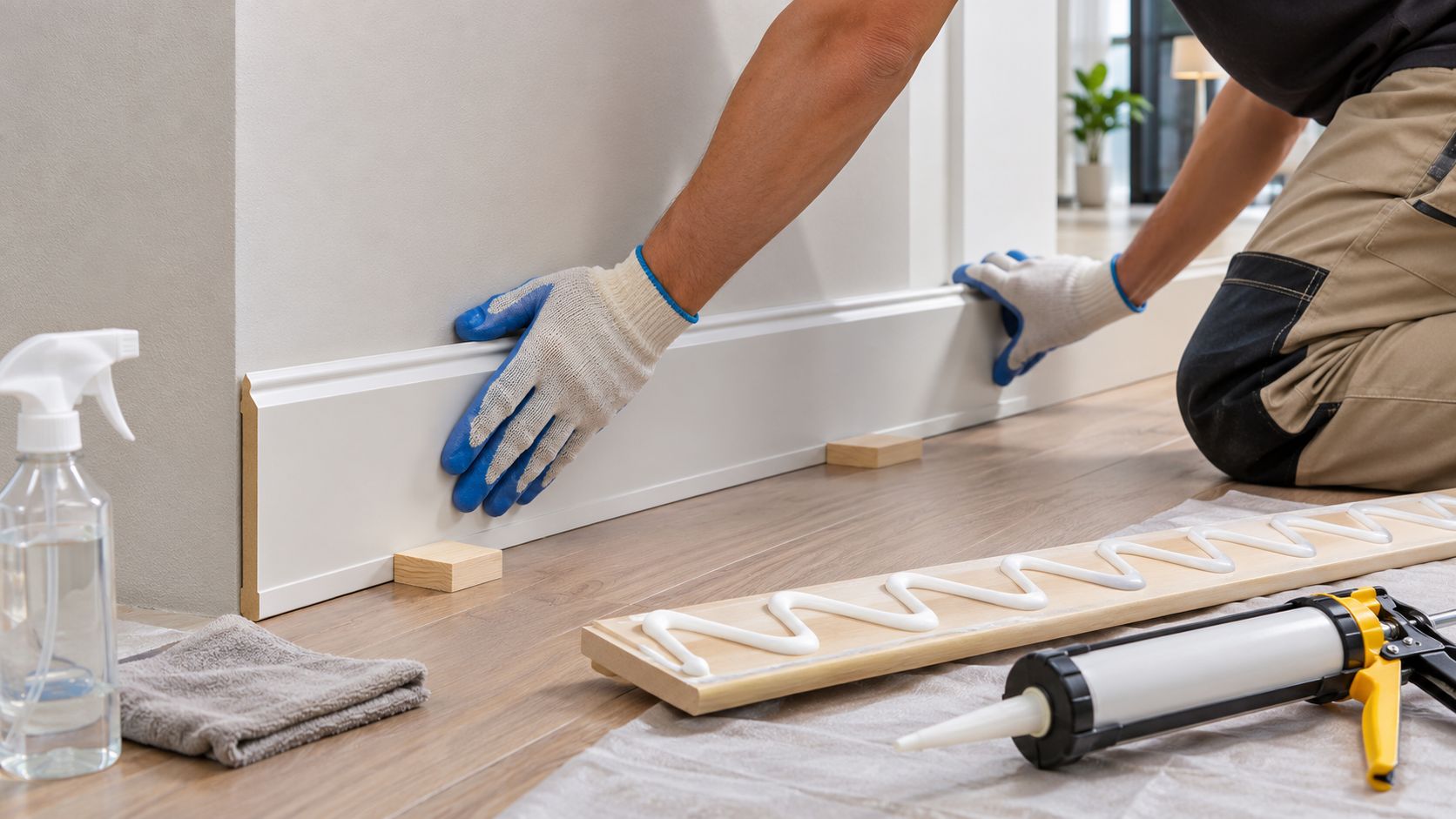
The end that sprang away during the dry fit hasn’t become straighter because the adhesive is ready. It still needs addressing through fit correction or an appropriate support arrangement. This is the point to gather the supports and work out where they’ll touch the finish, while everything is still clean.
Bead pattern, quantity and working time come from the chosen adhesive’s instructions. They can’t usefully be reduced to a universal spacing or waiting period here. A large amount dispensed isn’t evidence of contact with an uneven wall.
When you’re attending to one end, it’s easy to move the other and open a join you had fitted. Looking back along the run catches that before it’s concealed by the next operation. Once aligned and supported, the assembly needs the specified curing interval. A bead you can touch at the edge tells you little about the hidden joint.
Squeeze-out is a cleaning question for both glue and finish; an unapproved cleaner may leave a mark that wasn’t there before. Painting and caulking have to wait for the required curing condition. I’d inspect for movement or loose ends before covering the edges. Filling a line doesn’t make a detached board secure.
Product and Sample Enquiries with KINGDELI
For a purchaser arranging those trials, KINGDELI accepts sample enquiries. The Foshan adhesive and sealant manufacturer also lists small-quantity orders and OEM work. A sample discussion is useful when a backing hasn’t previously been tried with the proposed product.
White, cream, black and gray are the HY-963 color options on the product page. For packaging, the choices are a 280 ml or 300 ml cartridge; the stated shelf life is 18 months. You’ll need the application pattern to turn those volumes into an order quantity.
To open a product or sample enquiry, a brief account of the board, wall finish and indoor location is a useful start. Photos of a difficult corner can follow if needed.
Conclusion
I’d choose the cartridge after checking the backing, wall finish and fit. From there, the application instructions and curing requirements govern the work. The last look at the bond belongs before the edges are covered with paint or caulk.
FAQs
Can one adhesive trial cover every room?
Only if the relevant materials and surface conditions are equivalent. A newly prepared wall doesn’t represent older paint or a different board backing, so variations need their own review.
Is glass skirting compatible with any construction adhesive?
No. The glass may have a backing or coating that changes what you’re bonding to, so compare that surface with the product information. HY-963 lists glass skirting, but the actual wall and finish still need evaluating.
Can room length alone give a cartridge estimate?
Not reliably. Coverage also depends on the specified bead dimensions and pattern. The supplier’s application guidance should inform the estimate rather than an assumed number of metres per cartridge.