
Sealant Joint Depth: Why the 2:1 Ratio Matters
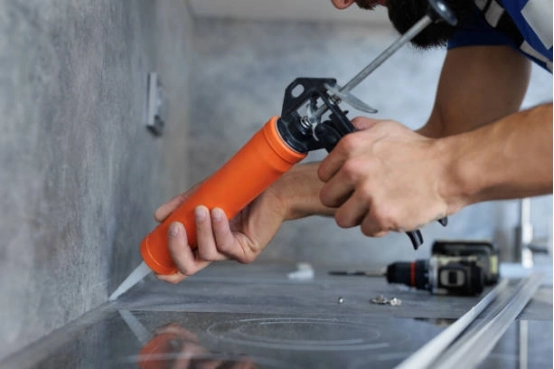
Sealant joint depth is not simply a quantity decision. It changes how a cured bead stretches, compresses and transfers stress to the joint faces. For many construction movement joints, a bead about twice as wide as it is deep is a useful starting geometry because it supports movement without adding unnecessary stiffness. The familiar 2:1 ratio is not universal, however. Product limits, joint width, orientation, substrate condition and the project specification must still define the final section.
A correct detail also needs two-sided adhesion. The sealant should normally bond to the two opposing joint faces while a backer rod or bond-breaker prevents adhesion at the bottom. That geometry is often more important than adding extra sealant.
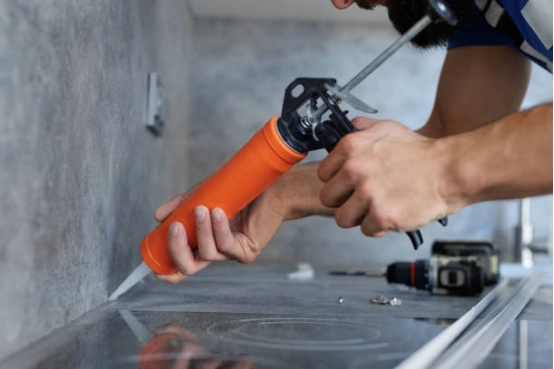
What Sealant Joint Depth Controls
Joint width is the distance between the two bonding faces. Depth is the thickness of sealant from the exposed surface to the backer rod or bond-breaker. Changing either dimension changes the bead’s shape factor.
An excessively deep bead contains more material and generally resists deformation more than a thinner bead of the same width. That can raise stress at the bond line as the joint opens. In moisture-curing systems, an unnecessarily thick section can extend through-cure time. A section that is too shallow may lack sufficient bonded area or become vulnerable to tearing, puncture or poor tooling.
Depth therefore has to work with the product’s modulus and movement capability. KINGDELI’s article on low- and high-modulus behavior explains the material side of that decision; joint geometry determines how those properties are used in the assembly.
Why the 2:1 Width-to-Depth Ratio Is Common
A 2:1 width-to-depth ratio means that a 20 mm-wide joint contains a sealant bead about 10 mm deep. When tooled over a backer rod, the center of the bead can be slightly thinner than its bonded edges, forming an hourglass-like section. This encourages deformation through the center while maintaining contact along the two joint faces.
| Joint Section | Likely Mechanical Effect | Design Response |
| Width about twice the depth | Balanced movement section for many conventional joints | Confirm the dimensions fall within the product data |
| Depth close to or greater than width | Higher material use and a stiffer bead | Raise the backer rod or revise the detail |
| Very shallow depth | Less bonded area and a thinner working section | Check minimum depth and tooling requirements |
The ratio does not select the chemistry, movement rating or application grade. A horizontal floor joint may need a self-leveling product, while a vertical facade joint requires a non-sag grade. KINGDELI’s comparison of self-leveling and non-sag sealants addresses that separate orientation decision.
What Backer Rod Does to Joint Geometry
Backer rod sets the sealant depth, supports tooling pressure and blocks contact with the joint bottom. Without that separation, the bead may adhere on three surfaces. When the joint opens, three-sided adhesion restricts the center of the bead and concentrates strain near the bonded edges. Adhesive or cohesive failure can then begin even when the selected sealant is nominally flexible enough.
The rod must stay at a consistent elevation and fit without leaving voids. An undersized rod can move during application; excessive compression or puncture can create other defects. Closed-cell, open-cell and hybrid backers behave differently around moisture, compression and air, so the sealant manufacturer’s compatibility advice and the project detail should govern the choice.
KINGDELI describes HY-923 low-modulus polyurethane sealant as a one-component, flexible construction sealant intended for joints with movement requirements and for bonding to cement and stone. Those published uses make it a relevant product family to review, but they do not replace a project-specific check of bead dimensions and movement demand.
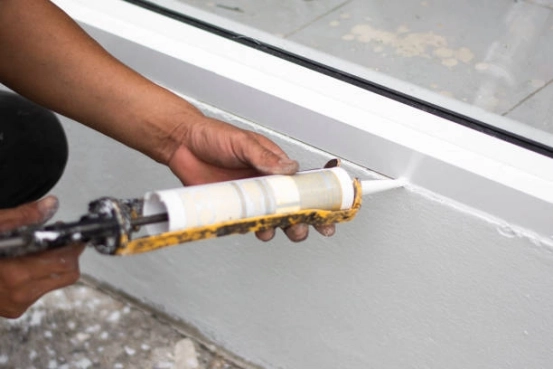
A Worked Joint-Dimension and Coverage Example
Consider an illustrative joint with nominal width W = 20 mm, sealant depth D = 10 mm and length L = 1 m. Assume, for design comparison only, that the expected movement is plus or minus 25% of nominal width.
Movement each direction = W x 25% = 20 mm x 0.25 = 5 mm
The joint would therefore be evaluated between 15 mm and 25 mm wide. That arithmetic does not prove that a particular sealant is suitable; its current technical data must allow the movement and the substrates must retain adhesion.
For a rectangular quantity estimate:
Volume per metre (mL) = W (mm) x D (mm)
The 20 mm by 10 mm joint consumes a theoretical 200 mL per metre. A 300 mL cartridge therefore covers 300 / 200 = 1.5 m before application loss. If the bead were incorrectly set 15 mm deep, consumption would rise to 300 mL per metre, 50% more material, while also producing a less favorable shape. KINGDELI’s 300 mL cartridge coverage calculation provides more quantity examples. Actual planning should add waste for joint variation, tooling and material left in the package.
When 2:1 Is Not the Right Assumption
Narrow joints can reach a product’s minimum permitted depth before a 2:1 section is possible. Very wide joints may have a maximum bead depth rather than continuing to scale proportionally. Static fillets, structural glazing bites and traffic-bearing horizontal joints also follow different design logic.
Substrates introduce further limits. Weak, porous or contaminated joint faces can fail before the sealant reaches its rated movement. Deep joints may require a different backing arrangement, while joints without room for backer rod may need an approved bond-breaker tape. Cure mechanism, application temperature, primer requirement and exposure to water or chemicals remain independent checks. Treat 2:1 as a geometry concept, not as permission to ignore the product data sheet or the project specification.
FAQ
These questions address common limits and misunderstandings around sealant joint depth.
Is a 2:1 Ratio Required for Every Sealant Joint?
No. It is a common starting point for many movement joints, not a universal rule. Product limits, joint size, orientation, service exposure and the approved project detail can require a different section.
How Deep Should a 10 mm Sealant Joint Be?
A 2:1 assumption suggests 5 mm. That depth may be below the permitted minimum for a particular product, so check the manufacturer’s stated depth range before fixing the backer rod position.
Should Sealant Bond to the Bottom of a Movement Joint?
Usually not. A compatible backer rod or bond-breaker helps maintain two-sided adhesion, allowing the bead to extend and compress without the restraint created by a third bonded surface.
Does a Wider Joint Automatically Handle More Movement?
At the same rated percentage, a wider joint can accommodate more absolute movement. It succeeds only if bead geometry, adhesion, substrate strength, installation quality and the sealant’s verified capability are all suitable.
Can Backer Rod Replace Primer?
No. Backer rod controls depth and prevents bottom adhesion. Primer, when required by the sealant system, improves or stabilizes adhesion at the two joint faces; the two components perform different jobs.
Review the Joint Before Product Selection
Before selecting a sealant, assemble the joint drawing, nominal width and depth, expected minimum and maximum widths, substrates, orientation, exposure conditions and installation temperature. Share those details through the KINGDELI contact page for a product-specific compatibility discussion. That review keeps the geometry, movement demand and material properties tied to the same real joint rather than relying on the 2:1 ratio alone.